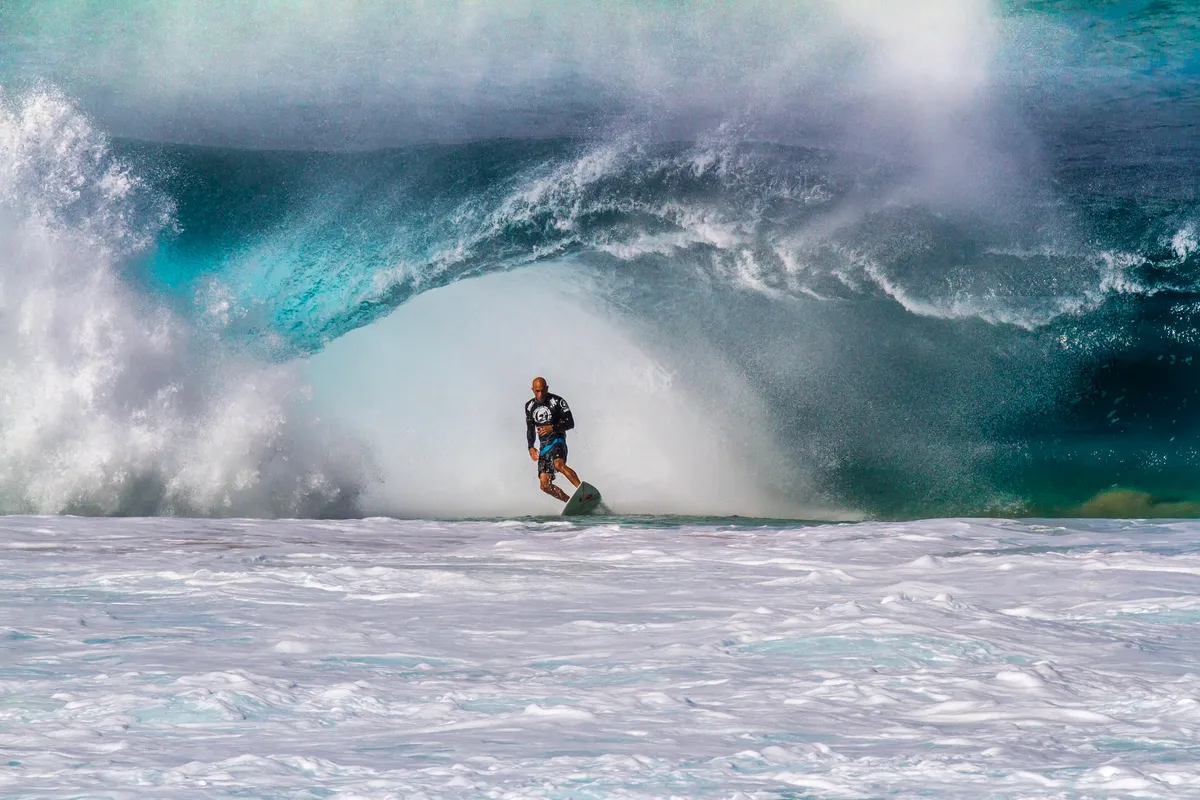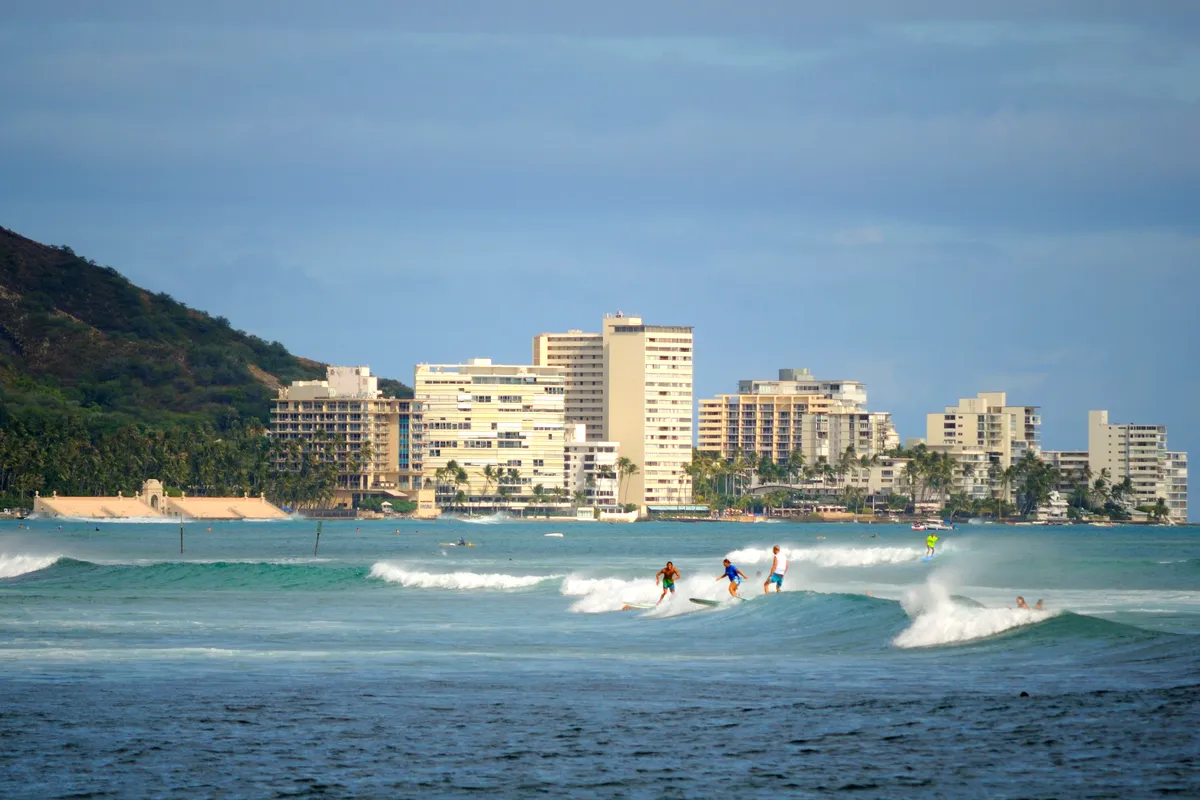
The breaks
Recognised, publicly known surf spots around Waikiki. Suitability depends on the day's swell, wind and tide, so treat the level as a guide, not a guarantee.
| Break | Type | Best for | Notes |
|---|---|---|---|
| Canoes | Reef break | Beginner | Slow, rolling peaks in front of central Waikiki, ideal for learning and outrigger canoe rides. Extremely busy. |
| Queens | Right-hand reef | Intermediate–Advanced | Longer, defined rights near the Duke statue, popular with longboarders and a strong local crew. |
| Populars (Pops) | Reef break | Intermediate | Outer reef offering longer, often less crowded rides for those willing to paddle out. |
| Publics | Right-hand reef | Intermediate | Right near Kapiolani Park that can be good on bigger south swells. |
| Ala Moana Bowls | Left-hand reef | Advanced | Hollow left beside the Ala Wai harbour entrance, one of the best south-shore waves on a good swell. |
Waikiki surf climate, measured
Ten years of ocean model data for the open water off this coast: what the swell usually looks like before it reaches the beach. Shelter, sandbars and reefs change what you actually surf, so read this next to the month notes below.
| Month | Swell | Period | From | Wind | Water | Wetsuit | Days over 2.5 m |
|---|---|---|---|---|---|---|---|
| Jan | 1.8 m | 14 s | NW | 16 km/h NE | 25°C | Boardshorts | 8% |
| Feb | 1.7 m | 13 s | NW | 24 km/h E | 25°C | Boardshorts | 10% |
| Mar | 1.6 m | 11 s | NE | 24 km/h NE | 25°C | Boardshorts | 8% |
| Apr | 1.6 m | 12 s | E | 29 km/h NE | 25°C | Boardshorts | 0% |
| May | 1.6 m | 12 s | E | 29 km/h E | 26°C | Boardshorts | 0% |
| Jun | 1.5 m | 13 s | E | 26 km/h E | 26°C | Boardshorts | 0% |
| Jul | 1.5 m | 12 s | E | 30 km/h E | 27°C | Boardshorts | 3% |
| Aug | 1.5 m | 11 s | E | 27 km/h E | 27°C | Boardshorts | 0% |
| Sep | 1.4 m | 11 s | E | 27 km/h NE | 27°C | Boardshorts | 0% |
| Oct | 1.5 m | 12 s | E | 25 km/h E | 28°C | Boardshorts | 5% |
| Nov | 1.6 m | 12 s | E | 26 km/h E | 27°C | Boardshorts | 0% |
| Dec | 1.7 m | 14 s | NE | 24 km/h NE | 26°C | Boardshorts | 5% |
Median values from ERA5 at a sea point near Waikiki (21°N, 157.75°W), sampled 4 days a month at 12:00 UTC, 2015-2024. Highlighted months are our suggested planning window. Not a forecast or a safety assessment. How we use this data.
Book a surf trip to Waikiki
Everything we can link you to for this trip, grouped by what you need. Before you pay a camp or school, read who holds your money, and check that your insurance covers surfing.
Where to stay
Search near the breaks. Filter for surf hostels, apartments or hotels once you can see the map.
Surf lessons and activities
Listings change by season, so check what the operator includes and who coaches.
Flights
Add your dates and check the board fee on every leg before you pay.
Car hire
Ask about roof racks and whether the insurance covers boards on the roof.
Airport transfer
Tell the driver you have a board and its length when you book.
Mobile data
Download a forecast app and offline maps before you land.
Flight delay claims
If a delay eats your first surf day, check whether you can claim.
Luggage storage
Useful between check-out and a late flight. Check the size limit before dropping a board.
Links marked as partner links may earn us commission at no cost to you; the rest earn us nothing. We have not checked live availability or price, and the seller's terms apply. How we handle this.
Cheapest months to fly to Waikiki
Lowest return fare to HNL that Aviasales users found recently, in US dollars. Treat these as a guide to which months are cheaper, not as prices you can book today.
| From | Nov 26 | Dec 26 | Jan 27 | Feb 27 | Mar 27 | Apr 27 |
|---|---|---|---|---|---|---|
| London | – | $1433 | $1251 | – | – | – |
| New York | $700 | $622 | $557 | $787 | $865 | $714 |
| Los Angeles | $232 | $342 | $361 | $364 | – | $455 |
| Sydney | – | – | $1305 | – | $615 | – |
| Frankfurt | – | $1275 | – | – | – | – |
Prices seen by 15 November 2026. Travelpayouts Data API. Board fees are extra on most airlines: see our surfboard baggage guide.
The birthplace of modern surf culture
Waikiki was a favoured place for surfing by Hawaiian royalty long before the arrival of Europeans. In the early twentieth century, as Honolulu grew and tourism began, local Hawaiian watermen known as the Waikiki beach boys taught visitors to surf and paddle outrigger canoes. Among them was Duke Kahanamoku, an Olympic swimming champion who became surfing's first international ambassador, demonstrating the sport in Australia, California and beyond.
Today, a bronze statue of Duke stands on Kuhio Beach, often draped in flower leis. The beach boy tradition continues, with instructors and canoe crews working from stands along the beach, and Waikiki remains a symbol of surfing's Hawaiian roots.
Why Waikiki's waves are so gentle
Waikiki faces south, sheltered from the giant North Pacific swells that hit the North Shore in winter. Its waves come mainly from south swells generated by storms in the Southern Hemisphere. Before reaching the beach, these swells cross wide, shallow reefs that sit well offshore, which slows them and turns them into long, rolling waves that break gradually rather than all at once.
That is why Waikiki is ideal for learning and for longboarding: the waves are slow, the rides are long and there is room to spread out across several breaks. On bigger south swells, some of the outer reefs become faster and more powerful.
Canoes and Queens
Canoes, in front of the central Waikiki beach, is the classic learner's wave, with slow, rolling peaks that are perfect for soft-top boards and outrigger canoe rides. It is extremely busy, with lessons, canoes and rental boards sharing the water, so awareness and board control matter.
Queens, just east near the Duke statue, is a right-hand wave that offers longer, more defined rides and is popular with longboarders and experienced local surfers. The line-up at Queens has a strong local crew and is not the place for beginners.
Pops, Publics and the outer reefs
Populars, usually called Pops, is a reef break further out in front of the Sheraton area, offering longer, often uncrowded rides for intermediate surfers willing to paddle out. Publics, near Kapiolani Park at the eastern end, is a right that can be good on bigger south swells.
Other breaks, such as Threes and Kaisers, lie further west towards the harbour, with faster, more powerful waves. Ala Moana Bowls, next to the Ala Wai harbour entrance, is a hollow left that is one of the best waves on the south shore on a good swell, best left to experienced surfers.
South-swell season
Waikiki's best surf comes from south swells, most consistent from roughly April to September, during the Southern Hemisphere winter. This is when the outer reefs come alive and the line-ups are busiest. Trade winds blowing from the north-east are often offshore or cross-shore on the south shore, helping to keep waves clean.
From October to March, Waikiki is generally smaller, but there are still waves for learners on most days, and the warm water and sunshine make it pleasant year-round. This is the opposite pattern to the North Shore, which is why many surfers split their time between the two coasts depending on the season.
Beach boys, lessons and outrigger canoes
Lessons in Waikiki are easy to find. Beach boy stands and surf schools along the beach offer group and private lessons, usually with large soft-top boards and instructors who push students into waves at Canoes or other gentle spots. Board rental is widely available.
Outrigger canoe surfing is a uniquely Hawaiian experience: crews paddle a canoe out to the waves and ride them back towards the beach. It is a fun way to experience Waikiki's waves even if you have never surfed.
Reef, crowds and staying safe
Although the waves are gentle, they break over shallow reef, so falling flat rather than diving in, wearing a leash and being careful at low tide help prevent cuts. Crowds are the main hazard at Canoes, with many beginners, canoes and boards in the same area. Stay aware, keep control of your board and avoid paddling into the path of others.
Lifeguards patrol Waikiki's beaches. The sun is strong all year, so use reef-safe sunscreen; Hawaii restricts the sale of some sunscreen ingredients that harm coral.
Sharing Waikiki's busy waves
Waikiki's gentle waves are shared by an extraordinary mix of people: first-timers on soft-tops, experienced longboarders, stand-up paddleboarders, bodyboarders and outrigger canoes carrying tourists. That mix works because of a few shared habits. Canoes have trouble stopping or turning, so give them a wide berth. Learners should stay in the areas their instructors choose, usually around Canoes, rather than drifting into Queens or Pops, where local surfers expect a higher standard.
Whoever is closest to the breaking part of the wave has priority, and on long rides at the outer reefs that means looking carefully before you paddle. Keep a hand on your board when ducking under waves, and if you make a mistake, a quick apology is welcome. Respect for the beach boys and local surfers is part of honouring Waikiki's place in surf history.
Diamond Head, Honolulu and staying in Waikiki
Waikiki is packed with hotels, from historic beachfront properties to budget options a few blocks back, along with restaurants, shops and nightlife. Honolulu's airport is about twenty-five minutes away. The city offers museums, including the Bishop Museum with its collection on Hawaiian culture, as well as Iolani Palace, the only royal palace in the United States.
Diamond Head, the volcanic crater at the eastern end of Waikiki, has a popular hiking trail with views over the coast. The North Shore is about an hour's drive away, an easy day trip to watch the big winter waves.
Waikiki surf season month by month
A broad planning picture, not a forecast. Swell, wind and water temperature vary from year to year.
| January | Small south-shore surf, but often enough for learners at Canoes. Warm water and winter sunshine. |
|---|---|
| February | Still small. A good time for lessons while the North Shore is huge. |
| March | Occasional early south swells. Comfortable for learning. |
| April | The south-swell season begins. Outer reefs start to work. |
| May | More consistent south swells and trade winds. Good for all levels. |
| June | Prime south-swell season, with busy line-ups at Queens and Bowls. |
| July | Consistent swells and crowded beaches. Book lessons early in the morning. |
| August | Still prime, with warm water and regular swells. |
| September | Good swells continue as the season winds down. |
| October | Smaller swells; learners still have waves at Canoes. |
| November | Mostly small, while attention shifts to the North Shore. |
| December | Small and warm, with holiday crowds on the beach. |
Learning to surf at Waikiki
Waikiki is arguably the most famous place in the world to learn to surf. Instructors from beach stands and surf schools take students to Canoes and other gentle spots on large soft-top boards, often pushing them into waves so they can focus on standing up. Many people ride their first waves within a single lesson.
Lessons are available all year, and the gentle conditions mean even winter days usually have suitable waves. Morning sessions are less crowded. Ask about group size and instructor experience, and learn basic etiquette for sharing busy waves with canoes and other surfers.
Comparing options across the country? Read our guide to surfing in the USA.
Seasonal notes on this page describe typical patterns, not the conditions on a given day. Use the local forecast, lifeguard advice and a qualified instructor for water-safety decisions, and get a written breakdown of what any surf package includes before paying.
Waikiki surf trip questions
Is Waikiki good for beginners?
Yes. Its slow, rolling waves over offshore reefs make it one of the world's best places to learn, especially at Canoes.
When is the best time to surf Waikiki?
From roughly April to September, when south swells are most consistent. Smaller waves for learners are available most of the year.
Who was Duke Kahanamoku?
A Hawaiian Olympic swimming champion and surfer from Waikiki who helped spread surfing around the world in the early twentieth century. His statue stands on Kuhio Beach.
Do I need a wetsuit in Waikiki?
No. The water is warm all year. A rash vest is useful for sun protection.
What is outrigger canoe surfing?
A traditional Hawaiian activity in which a crew paddles an outrigger canoe out to the waves and rides them back towards the beach. Rides are available on Waikiki Beach.
Waikiki or the North Shore?
Waikiki has gentle waves for learners and is best from April to September. The North Shore has powerful winter waves for experts from November to February and is often calm in summer.
Is Waikiki crowded?
Yes, especially at Canoes, where lessons, canoes and rental boards share the water. Early mornings are quieter, and outer reefs such as Pops can be less busy for intermediate surfers.
Sources & editorial notes
Destination context checked against the sources below. Base-selection and itinerary suggestions are Book & Surf editorial recommendations. Seasonal windows are broad planning suggestions, not measured forecasts or guarantees.
- Wikipedia: Waikiki ↗
- Wikipedia: Duke Kahanamoku ↗
- Wikipedia: Diamond Head, Hawaii ↗
- NOAA National Weather Service: Honolulu ↗
We do not claim to have personally surfed every break. Read our editorial standards.